Nepal-China Border Flash Flood: How Did This Devastating Disaster Happen?
Last updated: 8/27/2026 1:57:00 PM
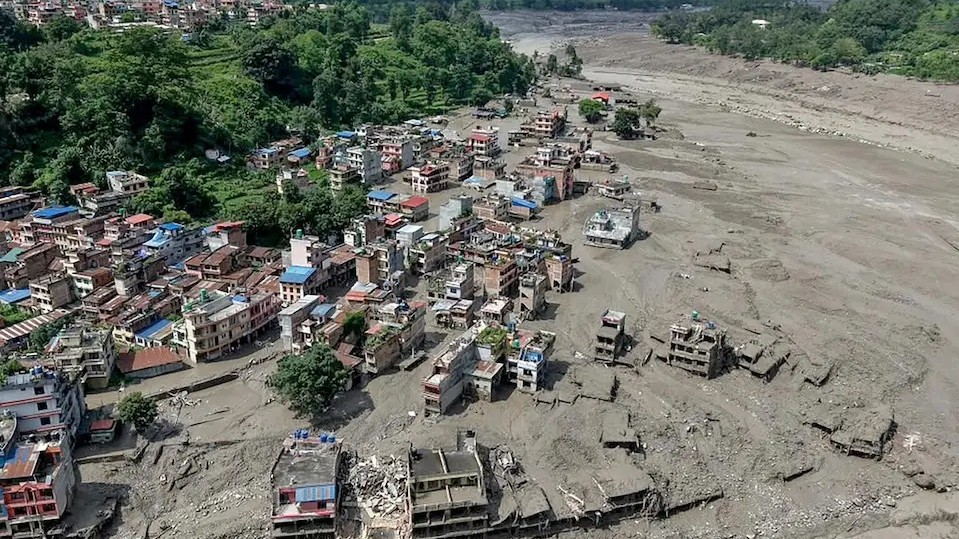
The devastating flash floods along the Nepal-China border were primarily triggered by a massive collapse of glacial ice and rocks. On August 26, a large mass of ice and rocks collapsed in the Lhende River valley in the Himalayas. The collapse combined with huge amounts of water, mud, ice and rocks, creating a powerful debris flow that rapidly moved downstream and triggered the catastrophic flash flood.
The powerful surge first struck the Bhotekoshi River and surrounding areas in Nepal’s Rasuwa district. The water and debris then spread downstream, causing widespread destruction in Nuwakot, Dhading and other areas. The same disaster also caused extensive damage in Gyirong, Tibet, China.
Before the disaster, a strong tremor was detected and initially thought to be an earthquake. However, the United States Geological Survey (USGS) later clarified that it was not an actual earthquake. The seismic energy was generated by the collapse of ice and rocks and the resulting debris flow.
In other words, this was not simply a conventional flood. The sequence was: glacial collapse → massive flow of ice and rocks → sudden surge of water and debris into the river → devastating flash flood.
Another important point is that, in this specific incident, it should not be stated with certainty that a natural dam first formed in the river and then broke. Based on the available information, the directly confirmed trigger was the collapse of glacial ice and rocks and the resulting debris flow.
Conditions:
You cannot use abusive words/sentences. You can't sneer at anyone. You cannot give aggressive statement to anyone.
More BNP